All-in-One vs. Best-of-Breed HR Software: Which Is Right for Your Irish SME?
Every growing Irish business eventually hits the same decision point: keep adding separate tools for payroll, recruitment, leave, and performance — or switch to a single connected platform that does it all. Neither answer is automatically right; it depends on where you are.
What "best-of-breed" actually looks like in practice
Best-of-breed means picking the strongest individual tool for each job — a payroll specialist, a separate applicant tracking system, a separate leave calendar, maybe a spreadsheet for performance reviews. Each tool can be excellent on its own.
The catch is what happens between the tools. Employee data has to be entered, or synced, or exported and re-imported across systems that weren't built to talk to each other. That's where things break:
- New starter details entered three times in three systems
- Leave approved in one tool but payroll still shows the old balance
- No single source of truth when a WRC inspector asks for records that match across payroll and time-tracking
What an all-in-one platform actually looks like in practice
A single connected platform holds employee records, payroll, leave, recruitment, and compliance data in one place. When someone updates a record, everything downstream reflects it — payroll, reporting, and compliance records included.
The trade-off is that no single all-in-one platform will always be the single best tool at every individual function compared to a specialist point solution — but for most SMEs, the value of one accurate, connected dataset outweighs marginal feature gaps in any one module.
When best-of-breed still makes sense
- You have a very specific, non-negotiable requirement in one area (e.g. a highly specialised recruitment tool for a niche industry) that no all-in-one platform covers well
- You're a very small operation where manual cross-checking between two or three tools is genuinely manageable
- You've already invested heavily in one specialist tool and switching cost outweighs the benefit right now
When an all-in-one platform makes more sense
- You're growing past the point where manual data reconciliation between tools is sustainable
- You need payroll, HR records, and compliance data to be consistent — especially with WRC inspections, auto-enrolment, and ERR reporting now live and enforced
- You want a single admin login and support relationship instead of managing four vendor relationships
- You're managing multiple sites, contract types, or a mix of staff categories (as with education employers)
Questions to ask yourself before deciding
- How much time does your team currently spend re-entering or reconciling data between systems?
- If a WRC inspector asked for matching payroll and time records tomorrow, could you pull them in minutes — or would it take days across multiple tools?
- Are you paying for overlapping features across separate subscriptions?
- Is your current payroll tool actually ready for auto-enrolment and ERR, or is that another gap to fill?
How CloudHR approaches this
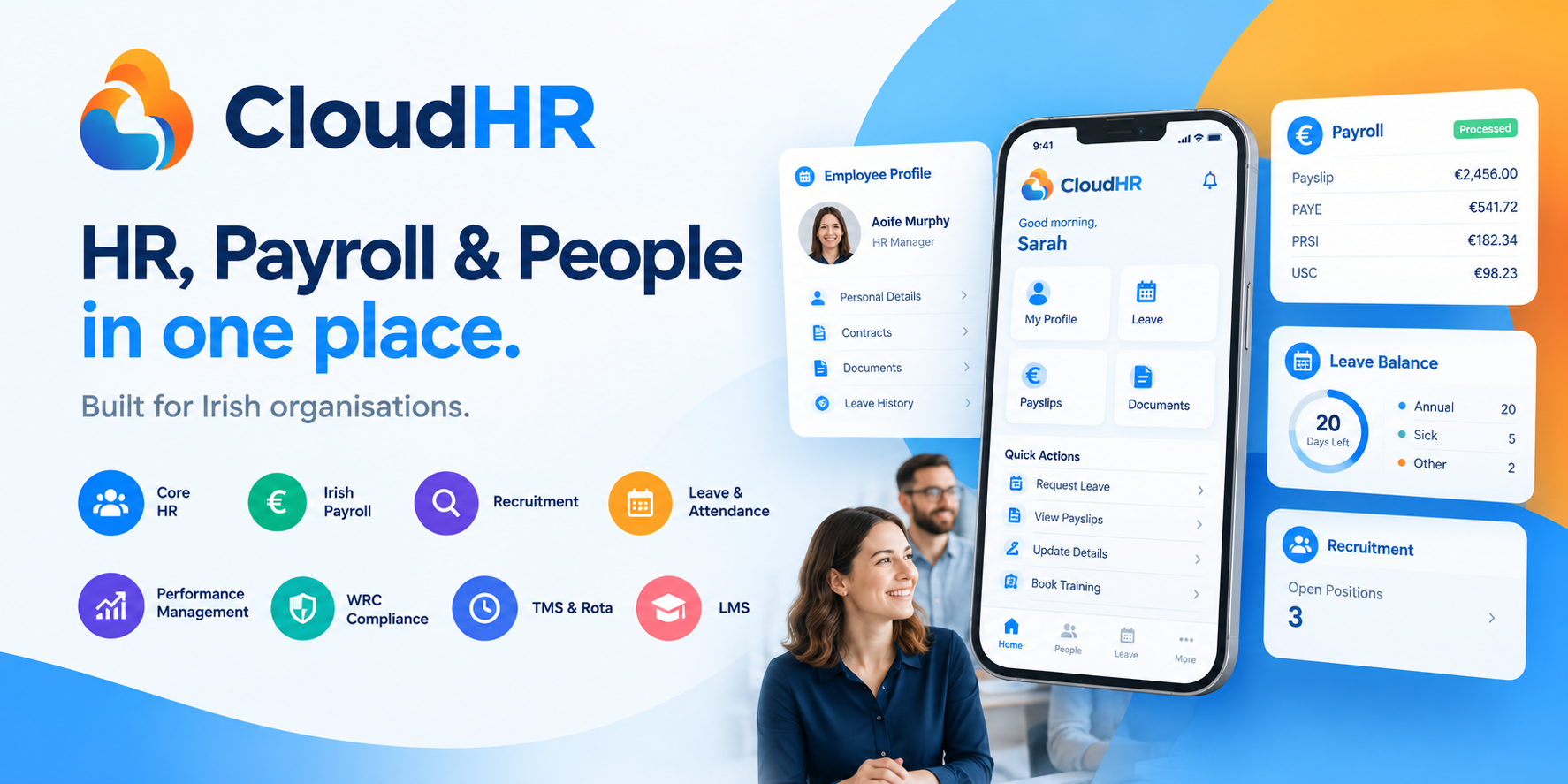
CloudHR is built as a single connected platform — core HR, Irish payroll, recruitment, leave, performance, WRC compliance, and rota scheduling all in one system — so data entered once (a new starter, a leave request, a contract change) flows through payroll and compliance records automatically, rather than needing to be re-entered or reconciled across separate tools.
FAQ
Is all-in-one HR software more expensive than separate tools? Not necessarily — while individual point solutions can look cheaper in isolation, the total cost of multiple subscriptions plus the admin time spent reconciling data often ends up higher than a single platform.
Can I migrate from several separate tools to one all-in-one platform? Yes — most all-in-one HR platforms support data migration from existing payroll, HR, and recruitment tools, though the time this takes depends on how clean your existing data is.
Does an all-in-one platform work for a very small business (under 10 staff)? Yes — many all-in-one platforms scale down to small teams with reduced pricing tiers, and the benefit of a single connected system applies at any size, not just at scale.
What's the biggest risk of a best-of-breed approach? Data inconsistency between systems — the most common practical example being payroll and time/attendance records that don't match, which is exactly what a WRC inspection checks for.
This article offers general guidance for Irish SMEs comparing HR software approaches — the right choice depends on your specific size, complexity, and existing tooling.