The Ultimate WRC Inspection Checklist: Is Your Irish SME Audit-Ready?
For any Irish SME owner or HR manager, receiving notification of a Workplace Relations Commission (WRC) inspection—or having an inspector walk through the door unannounced—can trigger instant panic.
The WRC carries out thousands of workplace inspections across Ireland every year, targeting sectors from retail and hospitality to logistics and professional services. Their primary objective? Ensuring full compliance with Irish employment law, the Organisation of Working Time Act, and statutory record-keeping obligations.
Failing a WRC inspection isn't just an administrative embarrassment. It can lead to formal fixed-payment notices, compliance notices, public naming-and-shaming, and heavy financial penalties.
The good news? WRC compliance is 100% predictable. If you have the right records organized, time-stamped, and readily accessible, a WRC audit becomes a routine 30-minute procedure rather than a week-long operational crisis.
This comprehensive guide breaks down the exact WRC inspection checklist, the mandatory records Irish employers must hold, common pitfalls to avoid, and how to ensure your business remains audit-ready 365 days a year.
What Happens During a WRC Inspection?
WRC inspectors derive their powers from the Protection of Employees (Employers' Obligations to Inform Employees) Act and various other pieces of Irish labor legislation. They have the legal right to:
- Enter premises at any reasonable time without prior notice.
- Examine records, books, and digital document vaults.
- Interview employers and employees individually or in private.
- Issue Compliance Notices or Fixed Payment Notices if breaches are identified.
Inspectors are generally checking for three core pillars: Proof of Employment Terms, Working Time & Rest Period Tracking, and Statutory Rate/Pay Compliance.
The Master WRC Inspection Checklist for Irish SMEs
To pass an audit without friction, you must be able to produce the following records covering a 3-year retrospective period (as mandated by Irish employment law).
1. Business & Employer Information
Before reviewing staff files, the inspector will verify basic legal entity details:
- [ ] Employer Registration Number (PAYE/PRSI details with Revenue).
- [ ] Full legal business name, trading names, and registered address.
- [ ] Names and contact details of company directors/owners.
- [ ] Total headcount breakdown (Full-Time, Part-Time, Temporary, Agency staff).
2. Core Employment Contracts & Terms of Employment
Under the Employment (Miscellaneous Provisions) Act 2018, employers must provide written terms of employment within specific statutory timeframes.
- [ ] Day 5 Statement: Proof that key terms (pay, hours, identity) were issued in writing within 5 days of starting.
- [ ] Full Written Contract / Statement of Terms: Fully executed, signed contracts issued within 1 month of commencement.
- [ ] Job Titles & Descriptions: Clear roles matching pay structures.
- [ ] Proof of Right to Work: Copies of passports, birth certificates, or legal work permits/Stamp 4 documentation for foreign nationals.
3. Organisation of Working Time Act Records (The #1 Breach Area)
The vast majority of WRC fines stem from poor record-keeping around working hours, breaks, and Sunday premium rates.
- [ ] Daily & Weekly Working Hours: Precise start times, finish times, and total hours worked per employee.
- [ ] Rest Break Logs: Proof that employees received a 15-minute break for 4.5 hours worked, and a 30-minute break for 6 hours worked.
- [ ] 11-Hour Daily Rest Period: Logs proving a minimum of 11 consecutive hours of rest between consecutive shifts.
- [ ] 24-Hour Weekly Rest Period: Proof of at least 24 consecutive hours of rest per 7-day cycle.
- [ ] Sunday Working Records: Clear proof that staff working Sundays received a premium allowance, paid time off, or an agreed statutory rate increase.
- [ ] Zero-Hour Prohibition Compliance: Verification that bandwidth/minimum hours were honored without illegal zero-hour contracts.
4. Annual Leave & Public Holiday Records
- [ ] Annual Leave Accrual Calculations: Detailed records of earned, taken, and remaining statutory annual leave (minimum 4 working weeks per year).
- [ ] Public Holiday Pay Calculations: Logs showing how public holiday entitlements were calculated for full-time and part-time staff (e.g., verifying part-time staff worked at least 40 hours in the 5 weeks prior to a bank holiday).
- [ ] Paid Sick Leave Logs: Proof of compliance with the Statutory Sick Pay (SSP) scheme (including medical certificates where applicable).
5. Payroll, Payslips & Minimum Wage Verification
- [ ] Gross-to-Net Payroll Records: Detailed breakdown of pay, deductions, and tax classifications (PRSI classes).
- [ ] Itemized Payslip Copies: Proof that employees received detailed itemized payslips for every pay cycle.
- [ ] National Minimum Wage Compliance: Proof that basic pay rates meet or exceed statutory minimum wage thresholds based on employee age/experience.
- [ ] Deductions Documentation: Written consent for any lawful payroll deductions (e.g., uniform deposits, till shortages).
6. Workplace Policies & Statutory Posters
- [ ] Dignity at Work Policy: Formal written policy addressing bullying, harassment, and sexual harassment.
- [ ] Disciplinary & Grievance Procedures: Written policies aligned with the WRC Code of Practice.
- [ ] Terms of Employment Notice: Displayed or easily accessible statutory workplace notices.
Top 4 Reasons Irish SMEs Fail WRC Audits
Knowing what inspectors look for is half the battle; avoiding systemic record-keeping errors is the other. Here are the most common reasons Irish businesses receive non-compliance notices:
1. Relying on WhatsApp and Paper Rosters
Many retail, hospitality, and service businesses still manage shifts through paper wall calendars or WhatsApp group messages. The WRC does not accept unorganized WhatsApp messages as official working time records. Without time-stamped, verifiable clock-in/clock-out records or confirmed digital rosters, inspectors will deem your business non-compliant under the Organisation of Working Time Act.
2. Miscalculating Public Holiday Pay for Part-Time Staff
Calculating bank holiday entitlements for part-time workers is a frequent source of manual error. Many employers either forget to pay part-time staff or apply incorrect formulas. If an employee worked 40+ hours in the 5 weeks preceding a public holiday, they are legally entitled to $1/5\text{th}$ of their average weekly pay for that day—even if they were not scheduled to work.
3. Missing Signed Employment Contracts
Having an employment contract stored somewhere in a desk drawer is not enough. If it isn't signed, dated, or accessible digitally within seconds, it creates immediate doubt during an audit. Furthermore, if you cannot prove when the terms were delivered (Day 5 requirements), you risk automatic statutory penalties.
4. Non-Compliant Rest Break Tracking
Inspectors frequently interview staff directly to verify if break rules are enforced. If your manual timesheets show identical "9:00 AM to 5:00 PM" blocks every single day without indicating rest periods, inspectors will flag it as falsified or incomplete record-keeping.
How Long Must You Keep Employee Records in Ireland?
Under Irish employment legislation and GDPR guidelines, employers must balance record retention requirements with data privacy rules:
Record TypeStatutory Retention PeriodWorking Time & Rest Break Logs3 Years (Mandatory under Working Time Act)Parental & Carer's Leave Records8 YearsNational Minimum Wage Records3 YearsGeneral Payroll & Tax (Revenue)6 YearsPersonal Data (Post-Employment)Delete after statutory retention window (GDPR compliance)
How Modern HRM Systems Guarantee "1-Click" Audit Readiness
Trying to maintain a 3-year paper trail for 5 to 50 employees using spreadsheets, physical filing cabinets, and scattered emails is a massive drain on operational bandwidth. It also exposes your business to human error.
This is where switching to an automated, Irish-compliant HRM platform like CloudHR.ie transforms your operational risk profile:
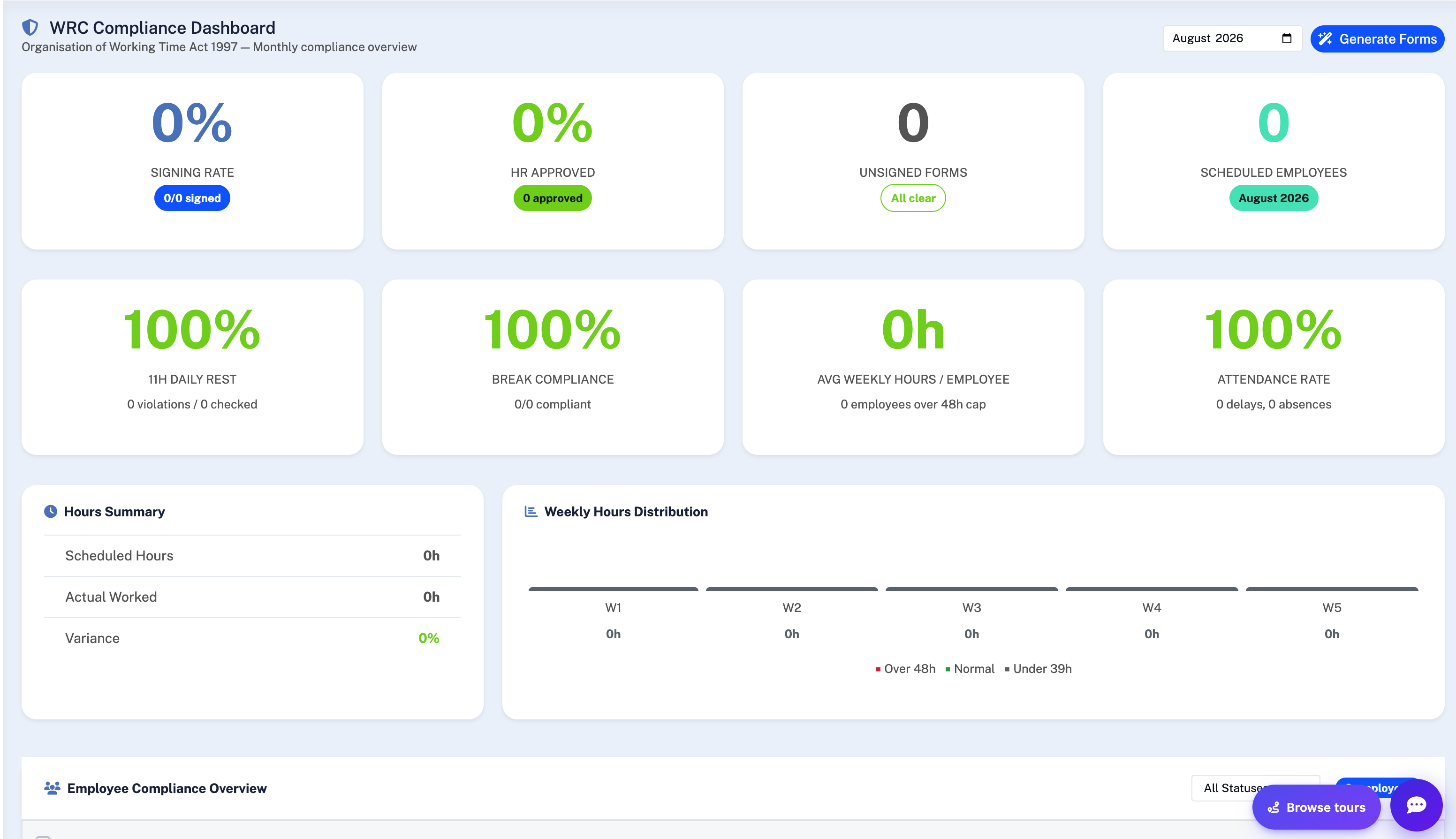
- Automated Time & Attendance: Digital clock-ins automatically capture start times, finish times, and rest breaks, creating time-stamped records that satisfy WRC requirements automatically.
- Built-in Irish Regulations: Statutory bank holiday pay, annual leave accruals, and PRSI rules are calculated automatically without manual math errors.
- Digital Contract Storage & eSignatures: Issue Day 5 statements and full contracts directly to new hires' phones. Contracts are signed digitally, time-stamped, and permanently secured in a searchable document vault.
- 1-Click WRC Audit Export: If an inspector arrives, you don't panic. You click "Export WRC Audit File," download a centralized, perfectly formatted digital archive of all required logs, and hand it over instantly.
Frequently Asked Questions (FAQ)
Can a WRC inspector enter my business without an appointment?
Yes. WRC inspectors have statutory powers to conduct unannounced workplace visits during normal operating hours.
What are the financial penalties for failing a WRC inspection?
Depending on the severity and nature of the breach, inspectors can issue Fixed Payment Notices (fines up to €2,000 per violation), formal Compliance Notices requiring immediate remediation, or refer the matter for court prosecution with fines up to €5,000+ per offense.
Does Excel count as a legal record-keeping system for hours worked?
While electronic records are permitted, manual Excel sheets are easily challenged if they lack time-stamps, change logs, or employee confirmation. Automated digital time-tracking platforms offer far greater legal protection.
Are digital signatures on employment contracts legally binding in Ireland?
Yes. Under the Electronic Commerce Act 2000, e-signatures on employment contracts are fully legally valid and recognized by the WRC and Irish courts.
Stop Living in Excel Hell. Lock Down Your WRC Compliance Today.
A WRC audit doesn't have to be a threat to your weekend, your finances, or your business reputation. By replacing fragmented spreadsheets and physical filing cabinets with a centralized workforce operating system, you clear the cognitive load of manual compliance forever.
Want to make your business 100% audit-ready in 5 minutes? Explore how CloudHR.ie automates Irish employment law compliance, digital contract signatures, and shift rostering for busy SME teams.